14 Aug, 2026
The Backdoor is in the Silicon: Why Defence Needs Chips a Country Can Verify
Two stories, unfolding weeks apart and thousands of miles away, reveal the same story from opposite ends of the world.
In the UK, a routine security scan found that a Chinese-made camera component inside the Royal Navy's K3 Scout sea drones had been quietly sending “heartbeat” signals back to China. The Ministry of Defence cut the connectivity and said no sensitive data was taken.
Let's pause for a moment and consider how it was even possible. A frontline naval platform, one also used by US Special Operations and NATO, carried a part nobody had fully inspected, doing something nobody had authorized, found only by accident.
The UK caught its problem by chance. But in another continent, India seems to be trying not to rely purely on luck. In fact, the Indian Ministry of Defence has moved proactively by putting out a new framework to weed out Chinese components from military drones. The framework is unusually specific about what a ‘secure’ drone has to mean.
Drone hijacking exposed risks of hidden foreign components
Drone manufacturers and suppliers to Indian defence forces must disclose the full origin of their hardware, along with every piece of embedded software and third-party firmware on the platform, so the state knows exactly what is inside a drone and who built it. Each component has to be traceable and certified, backed by verification reports rather than vendor assurances.
Data links must use strong encryption and secure transmission, and drones are barred from syncing with apps or systems from untrusted sources. Drones already in service face periodic audits of their components, software integrity and firmware updates, not just a one-time check at the point of purchase. And for high-risk deployments, the framework requires kill-switches, the ability to remotely disable a drone if it is compromised or captured.
This push to weed out Chinese components from military drones seems to have come after a real scare. An Army drone near the northern border was reportedly hijacked, and the cause traced to a Chinese-made autopilot.
Two continents, one lesson learned
Different countries, but the same lesson learned. A drone, a radio, or a missile is only as trustworthy as the silicon inside it and today almost none of that silicon is designed, fabricated, or even inspectable at home.
Is software the best fix?
The instinct is to fix this in software: encryption, secure boot, monitoring, etc. But software has to run on a chip. Whoever controls the silicon sits underneath your entire security stack and you cannot patch your way out of a compromised board. A tampered chip can lie to every layer above it, including the code you wrote to detect tampering.
The honest and the only fix is a dedicated security chip. And here, most sovereign countries hit two walls. The secure elements on the market are mostly foreign-designed black boxes. You can integrate them, but you cannot see inside them. And countries like India cannot yet fabricate advanced silicon at home, so even a chip designed at home must be built at a fab that the state does not control. Either way, the trust is asserted by a vendor or a foundry, not verified by the nation whose forces depend on it.
Open, inspectable secure silicon as solution
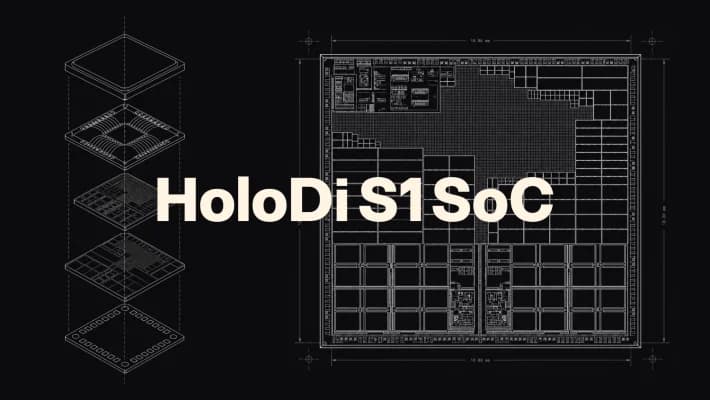
HoloDi, our product, is built to break that trap. It is an open, inspectable, sovereign security chip. The design is public, so anyone can audit exactly how it works instead of taking a datasheet on faith.
But an open design still has to be fabricated somewhere, and today that somewhere is abroad. So HoloDi is built to be verified locally even when the die is made at a foreign fab. Through infra-red in-situ (IRIS) verification, the finished chip is imaged on home soil and checked against the open design, down to its physical structures. If a foreign fab added or altered anything after tape-out, the check surfaces it.
Flipping the trust model
That flips the trust model. You no longer have to trust the fab. You trust two things you control: a design you can read and a physical verification you can run yourself, on your own soil.
And it does not stop at hardware, because a clean chip running compromised code is no safer.
Sovereign silicon means proving what’s inside
HoloDi's firmware and bootloader are reproducible. They can be rebuilt bit-for-bit from public sources, so the code in the root of trust (RoT) can be proven identical to the code that was initially loaded at the fabrication time. No hidden blobs at the most privileged layer of the system.
HoloDi brings open design that anyone can inspect from the hardware to the firmware-level. IRIS verification that catches a backdoored die at home. Reproducible firmware and bootloader with nowhere for hidden code to hide. That is what sovereign silicon actually means. Not a chip stamped “made here”, but a chip you can prove is what it claims to be.
The UK got lucky. A routine scan caught it. The next country may not.
Sovereignty in defence does not begin at the airframe, or in the software. It begins at the silicon, and in the power to verify it yourself.
Ledgerless provides secure hardware solutions integrated with customized firmware and attestation software rooted in the design of its HoloDi S1 SoC.
HoloDi S1 SoC is an open, inspectable, sovereign security chip. Public by design and independently verifiable throughout the whole stack. HoloDi protects critical infrastructure by enforcing security rules directly on the silicon layer.